Tuesday, August 19, 2014

Fab 5 - Buchu

Buchu belonging to the citrus family, Rutaceae are ericoid like shrubs (plants with needle like leaves) they are indigenous to South Africa and are cultivated for its essential oil and as an ornamental. Some plants are known for their medicinal properties like Agathosma betulina and Agathosma crenulata. Buchu is part of the cultural heritage of the San and Khoi people. They used these plants to relieve stomach related problems. Buchu is still used in South Africa as a household medicine for treating stomach, kidney and urinary tract infections as well as for external wounds and bruises.

Buchus are really good garden plants once established in the garden. Almost all the buchu do exceptionally well in coastal gardens as majority naturally occurring there. They can tolerate nutrient poor soils, sandy soils, are wind resistant and cover their bushes with flowers around August to October.

For this Fab 5 I'll be focusing on the flowers and smell of these plants, if you need more information on the plant i.e. how to grow it: visit http://www.plantzafrica.com/

Coleonema album commonly known as the white confetti bush or assbossie has a sweet honey fragrant and when in flower the entire bush is full of white dainty flowers.


Acmadenia heterophylla has a sweet lemony scent when the leaves are touched. and bears a variety of pink starry flowers.
Agathosma ovata "Outeniqua" is commonly known as the false buchu. It has white flowers and once in full flower attracts a large about of bees. This variety may grow up to 2m high.


Agathoma serpyllacea flowers in clusters of white,pink or purple, has a sweet lemony scent, and can also be grown as a pot plant. 
Agathosma mucronulata has a pungent almost turpentine-like scent when touched. The flowers of this buchu is easy to identify by looking at the small dots on the petals.

Tuesday, June 3, 2014

Protea magnifica


Protea magnifica has the second largest flower head after Protea cynaroides, the King Protea. The Queen Protea is one of the most attractive and sought after proteas.  No picture can describe how beautiful and fluffy it is, with its variable forms and colours in nature and its rounded bushy form. This protea will look great in any environment.

It is cultivated as a cut-flower for the export market because of its excellent cut flower characteristics of having long stems, long lasting flower heads and a good vase life. The air and sea freight ability is very good therefore it has remarkably high economic potential, as regular enquires from all over the world attest. It is considered the most prized cut flower in the trade, as its flowers can  last very long and looks great in dried flower arrangements.

Protea magnifica is a spectacular garden shrub in many situations. It requires good drainage and will not do well in damp, humid gardens.  It prefers to be planted in full sun and must have good air circulation.

It is an easy plant to grow in well-drained acid soils and can tolerate frost till about -8 ÂșC and can withstand some wind, but may show signs of foliage burn from excessive salt winds. They do not grow well along coastal ranges that are covered with moist fog through the year.

Do not disturb their roots as protea roots are very susceptible to infection if they are tampered with. Proteas are light feeders that adapted to very nutrient-poor soils and will die with the use of strong fertilizers and manure.

To read my full article on Protea magnifica go to http://www.plantzafrica.com/

Tuesday, March 11, 2014

Clivia bulbs

Clivia miniata  commonly known as the bush lily or Natal lily is easy to grow in pots.

The world started loving clivias in the beginning of the 1800s when specimens were sent to England from Kwazulu- Natal. It was then a very popular indoor plant in Europe and England, and is still an interest and loved plant by many gardeners.

These indigenous bulbs with their lovely shaped leaves and spectacular heads of trumpet-shaped to tube shaped flowers put them among our most attractive bulbous plants and form part of the Amaryllidaceae family .

The first clivia to be described was Clivia nobilis (1828)
Clivias have become popular in recent years, especially with all the beautiful cultivars of various colours found. Some of the harder to find types have become collector's items.

Clivia cultivar with yellow centers, cream to salmon tips

Clivias thrive in shaded spots in the garden.

Clivia miniata loves growing in shade

Sunday, November 24, 2013

Fab 5 - Pincushions

The fab 5 for this month is leucospermums commonly known as pincushions, they form part of the Protea family Proteaceae and there is 48 species in the genus. Most leucospermums occur in the Western Cape of South Africa. A lot of the species are popular as cut flowers and as garden plants.

Flowers of pincushions are mostly pollinated by sun birds and sugar birds, once seeds are ripe they are released immediately. In the wild the seeds will fall on the ground and get buried by insects or ants. During a fire (which is common in the Western Cape) the mother plant will die but the seeds underground will germinate and replenish the population.

Leucospermum muirii
Leucospermum muirii is an endangered bushy shrub growing up to 1.5m tall. The leaves are pale grey green and it bares yellow flowers from August to October.


Leucospermum cordifolium

Leucospermum cordifolium bares the most flowers from July all the way till the end of November. Flowers are orange and an added attraction is the numerous bird species found pollinating them when they in full flower.


Leucospermum reflexum var. luteum

Leucospermum reflexum commonly known as the rocket pincushion is a rounded silvery grey leaved shrub that grows up to 4m tall with either yellow or deep orange to crimson flowers.


Leucospermum erubescens
Leucospermum erubescens grows naturally on hot, dry, north facing slopes. Flowers are rounded and are produced in clusters of up to four heads per stem. The flower colour changes constantly as it ages from bright orange to deep red and normally last on the bush for about 2 months.


Leucospermum bolusii
Leucospermum bolusii is quiet unusual for a pincushion in that it flowers are creamy white in colour, where other pincushions are normally orange or yellow. They grow to about 1.5m tall and flower heads are flat and rounded. Flowering from mid September to early November they are pollinated by bees, wasps, flies, butterflies and moths. The species is named after Harry Bolus (1834-1911) a South African botanist.

These fab 5 pincushions are very different from each other but will all look beautiful in home gardens.

Wednesday, September 18, 2013

Tienie Versfeld Wildflower Reserve

Spring is seen as a time of growth and new life in both plants and animals, for me it is the best season to see beautiful flowers!

Tienie Versfeld Wildflower Reserve in Darling is a great place to view our renosterveld flowers. The reserve was originally a part of the farm Slagkop owned by the Versfeld family from Darling.
In 1953 the owner Mr Marthinus Versfeld (also known as Oom Tienie) donated the 20 ha farm to the National Botanical Institute because of its conservation potential. The reserve is open throughout the year but flower viewing is best from August to October.

These are just some of the reasons to visit the reserve and other reserves around Darling.

Wachendorfia brachyandera growing low inbetween the grasses.


Mating butterflies, such a treat to see and photograph.

Grasshopper, one of many seen on the day.

Geissorhiza radians commonly known as winecups or satin flowers.

Pauridia canaliculata offers flower seekers fine displays of brilliant, floral stars.

Osteospemum monstrosum has beautiful yellow flowers with dark brownish purple centers.

Lachenalia pallida just look at all those colours!

Friday, July 19, 2013

Fab 5 - Ericas

The genus Erica has about 860 species in them and of that 860 species South Africa is home to 760. Their flowers have many different shapes from bottle to globe to tube to urn shaped flowers and they are mostly pollinated by birds, insects and the wind.

I always thought Erica species was such a typical fynbos plant, with their small growth habit and needle like leaves, but after seeing them in flower I look at them differently because they are such beautiful plants and easy to maintain if they are given what they need.

This month's Fab 5 wasn't easy because I was exposed to so many amazing Erica sp. It was difficult to choose only 5. I selected the best 5 flowering Erica sp. I could find (and photograph). 


Erica baccans
Erica baccans produces bright cherry pink splashes of colour. Its common name is berry heath and is grown easily in a variety of garden conditions it even grows well in a pot. They are in full flower from September to November.


Erica patersonii
 The bright golden yellow tubular flowers are arranged in closely packed spikes. Flowering stems resemble corn on the cob, giving its common name Mealie heath. It is listed as rare and occurs in wet or marshy areas along the Western Cape. They are threatened by urban expansion and farming.


Erica blenna
 Flowers are bright orange with green tips and are sticky. They flowers from April to November. This Erica is relatively small because it is a slow grower. It is one of the most magnificent Ericas and is well known.


Erica leucotrachela
 Erica leucotrachela has two toned tubular flowers flowering from May to October. The species is found on mountain peaks between Rooi-els and Palmiet River and is endemic to Betty's Bay. It loves growing in moist cool conditions. This Erica really reminds me of Christmas because of its red and white flowers.


Erica haematocodon
 Erica haematocodon has deep red bell-shaped flowers and is listed as a rare plant. They are in full flower from December to February and occur naturally on rocky slopes of Cape Peninsula.


These photos were taken at Kirstenbosch National Botanical Gardens, most of these Ericas are grown and cultivated here as many of them are endangered or rare in their natural habitat. This is only 5 of many beautiful Ericas displayed in the numerous sections of the garden. Once you see some of them you'll notice how enticing they are and it could just lead to a lifetime of interest.

Saturday, July 13, 2013

Lachenalia bulbs


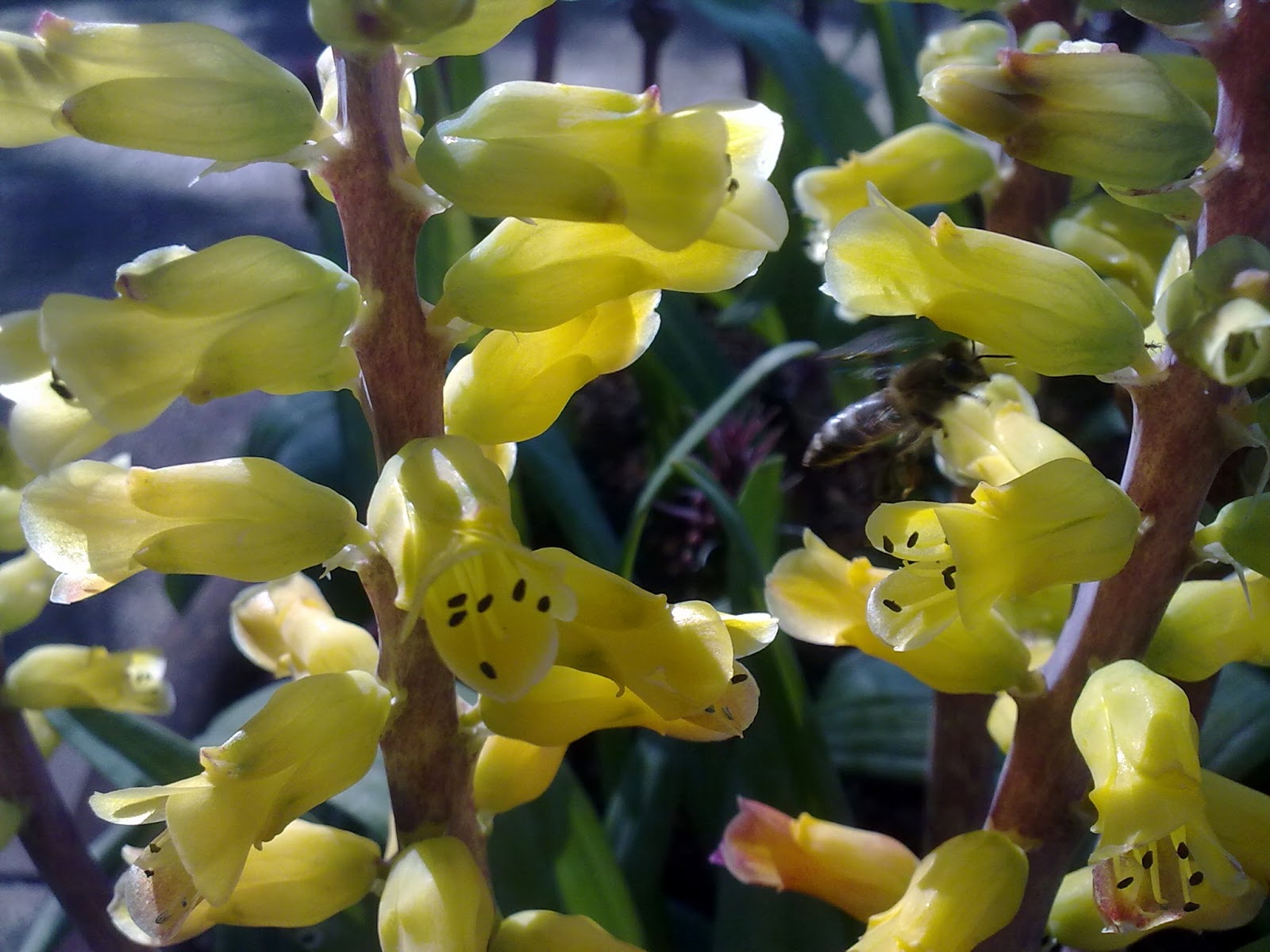
Lachenalia come in many colours like this one consisting of red, yellow, orange, purple and green.

One of my favorite bulbs is Lachenalia also know as the Cape cowslip. They belong to the Hyacinthaceae family and are deciduous perennials. They normally get one to several leaves but usually only two is seen. They flower in racemes or spikes. Flowers are more or less zygomorphic meaning its symmetrical when cut in half. Flowers are often described as nodding because their flowers are hanging. They come in many shapes, bell shaped, tubular shaped, cylindrical or urn shaped. They are variously coloured and often scented.


Flowers are often described as nodding.

Lachenalia viridiflora an endangered blue species.


Different flowers have different shapes and flower in recemes or spikes, in this case its flowering in a spike.

Most Lachenalia sp. are easy to grow and are often very attractive, making them well worth cultivating. Their small size combined with their variously coloured flowers make them ideal pot plants although mass plantings in the garden of some species look great in gardens, giving the garden a different look when it all flowers.


Lachenalia trichophylla is a great pot plant because of its hairy leaves and different growth.


These bulbs will bring colour and texture into any house and garden and are generally easy to grow.

Mass plantings in gardens will look lovely especially with bright yellow species.


This bulb is a beautiful low maintenance plant when they deciduous u forget about them and when they in flower they bring such beautiful colours back into the house and garden, its a must have for all bulb lovers.


Attracting bees and other friendly insects into your garden.
All of the pictures of these bulbs were taken at Kirstenbosch National Botanical Gardens in the conservory and in the nurseries, being a temporary student in the gardens I have the advantage of seeing these beautiful plants being grown and get to take pictures through out the day. Lucky me!